
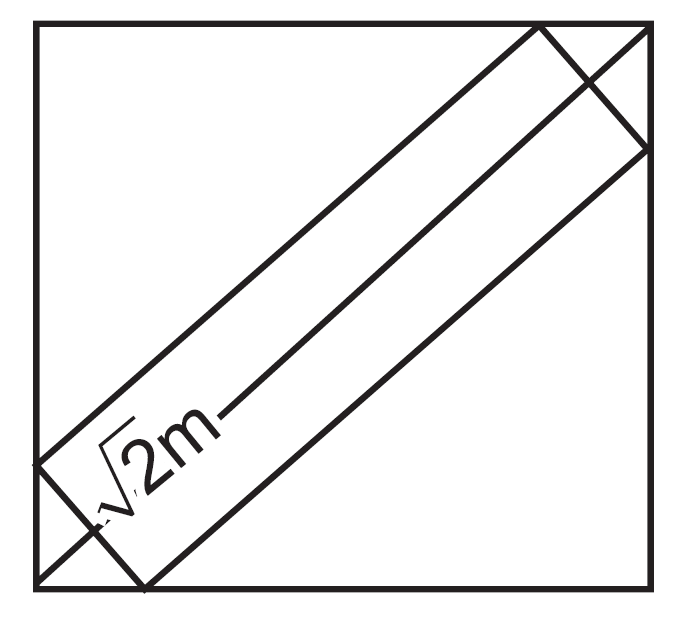
A rectangular plank $\sqrt{2}$ metre wide is placed symmetrically on the diagonal of a square of side 8 metres as shown in the figure. The area of the plank is
Aptitude
Area
Difficulty: Hard
Choose an option
-
A$7\sqrt{2}$ sq. m
-
B14 sq. m
-
C98 sq. m
-
D$(16\sqrt{2} - 3)$ sq. m
Answer
Correct Answer: 14 sq. m
Explanation
### Concept & Geometry of Diagonals
The plank forms a rectangle placed centrally over the diagonal of the square. Because the plank is constrained within the square, its ends are cut perpendicular to its length, creating small $45^\circ-45^\circ-90^\circ$ right triangles at the square's corners.
$$ \text{Diagonal of Square} = \text{side} \times \sqrt{2} $$
### Step-by-Step Solution
1. The side of the square is $a = 8$ m.
2. The length of the square's diagonal is $D = a\sqrt{2} = 8\sqrt{2}$ m.
3. The plank is placed symmetrically along this diagonal. Its width is $w = \sqrt{2}$ m.
4. This means the plank extends $\frac{\sqrt{2}}{2}$ m on either side of the diagonal line.
5. Look at the corner of the square where the plank ends. The corner of the square forms a $90^\circ$ angle, and the diagonal bisects this into two $45^\circ$ angles.
6. The end of the plank is perpendicular to the diagonal, creating an isosceles right triangle at the square's tip.
7. The height of this small corner triangle (from the square's vertex to the end of the plank) is exactly half the plank's width: $\frac{\sqrt{2}}{2}$.
8. In an isosceles right triangle, the hypotenuse (the cut end of the plank) is twice the height along the symmetric axis: $2 \times \frac{\sqrt{2}}{2} = \sqrt{2}$. This confirms the plank remains a perfect rectangle inside the square.
9. The length of the plank, $L$, is the total diagonal minus the parts cut off at both ends.
$L = \text{Total Diagonal} - 2 \times (\text{distance from corner to plank end})$
$L = 8\sqrt{2} - 2 \left( \frac{\sqrt{2}}{2} \right) = 8\sqrt{2} - \sqrt{2} = 7\sqrt{2}$ m.
10. The area of the rectangular plank is $L \times w$:
$\text{Area} = 7\sqrt{2} \times \sqrt{2} = 7 \times 2 = 14$ sq. m.
### Exam Strategy & Shortcut
Instead of complex geometric derivations, use the diagonal property. The plank trims a small isosceles right triangle off each end of the diagonal. Because the slope is $45^\circ$, the length removed from the diagonal at each end exactly equals half the plank width.
Length = $8\sqrt{2} - \frac{\sqrt{2}}{2} - \frac{\sqrt{2}}{2} = 7\sqrt{2}$.
Area = $7\sqrt{2} \times \sqrt{2} = 14$.
### Common Pitfall
Assuming the length of the plank is equal to the full diagonal of the square ($8\sqrt{2}$) without accounting for the fact that a rectangular plank with finite width cannot fit completely into a sharp $90^\circ$ corner without extending beyond the square.
### Final Answer
Therefore, the correct answer is **14 sq. m**.