
Consider the given figure.
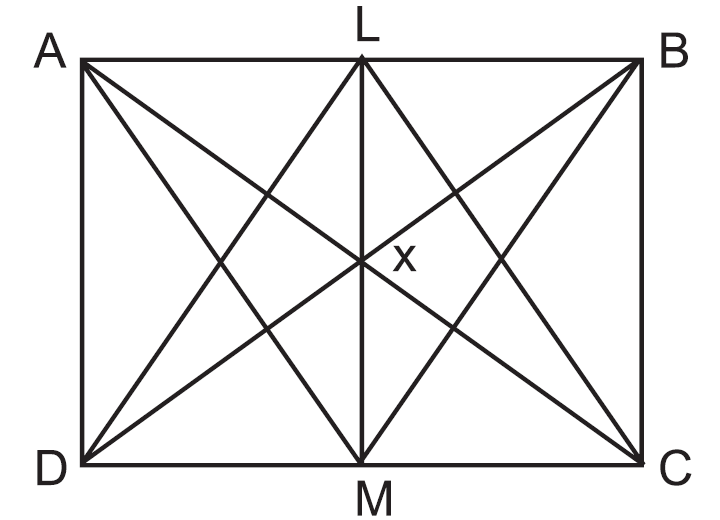 If the areas of the triangles $LDC$, $BMC$ and $AMC$ are denoted by $x$, $y$ and $z$ respectively, then
Aptitude
Area
Difficulty: Medium
Choose an option
-
A$x = y = z$
-
B$x = 2y = 2z$
-
C$y = 2x = 2z$
-
D$z = 2x = 2y$
Answer
Correct Answer: $x = 2y = 2z$
Explanation
### Concept & Triangle Areas in a Parallelogram
When triangles are inscribed within a parallelogram (or rectangle) and share the same height, their areas are directly proportional to their bases.
Area of a triangle: $$A = \frac{1}{2} \times \text{base} \times \text{height}$$
### Step-by-Step Solution
* **Given:** Figure $ABCD$ (assumed to be a standard parallelogram/rectangle based on typical geometry problems of this type), with $L$ and $M$ as midpoints of $AB$ and $CD$.
* **Analyze Triangle LDC ($x$):** The base is the full length $DC$ and the height is the perpendicular distance between parallel lines $AB$ and $CD$.
Area $x = \frac{1}{2} \times DC \times \text{height}$.
* **Analyze Triangle BMC ($y$):** The base is $MC$, which is exactly half of $DC$ ($MC = \frac{1}{2}DC$). The height from $B$ to the line containing $DC$ is the exact same as the height of the main figure.
Area $y = \frac{1}{2} \times MC \times \text{height} = \frac{1}{2} \times (\frac{1}{2}DC) \times \text{height} = \frac{1}{4} \times DC \times \text{height}$.
Therefore, $y = \frac{1}{2}x$, which means $x = 2y$.
* **Analyze Triangle AMC ($z$):** The base is $MC$, which is half of $DC$. The height from $A$ to the line containing $DC$ is also the same full height.
Area $z = \frac{1}{2} \times MC \times \text{height} = \frac{1}{4} \times DC \times \text{height}$.
Therefore, $z = y$, which means $x = 2z$.
* **Combine Relations:** We have $x = 2y$ and $x = 2z$. Combining these gives $x = 2y = 2z$.
### Exam Strategy & Shortcut
Visually assess the proportions. $\Delta LDC$ takes up exactly 50% of the area of the entire shape. Because $M$ divides the bottom base in half, $\Delta BMC$ and $\Delta AMC$ each take up 25% of the area (half of half). Thus, area $x$ is twice the size of areas $y$ and $z$, making $x = 2y = 2z$.
### Common Pitfall
Overcomplicating the problem by trying to prove complex geometrical congruence between all the smaller internal intersection triangles instead of just stepping back and comparing the primary bases and heights.
### Final Answer
Therefore, the correct answer is **$x = 2y = 2z$**.