
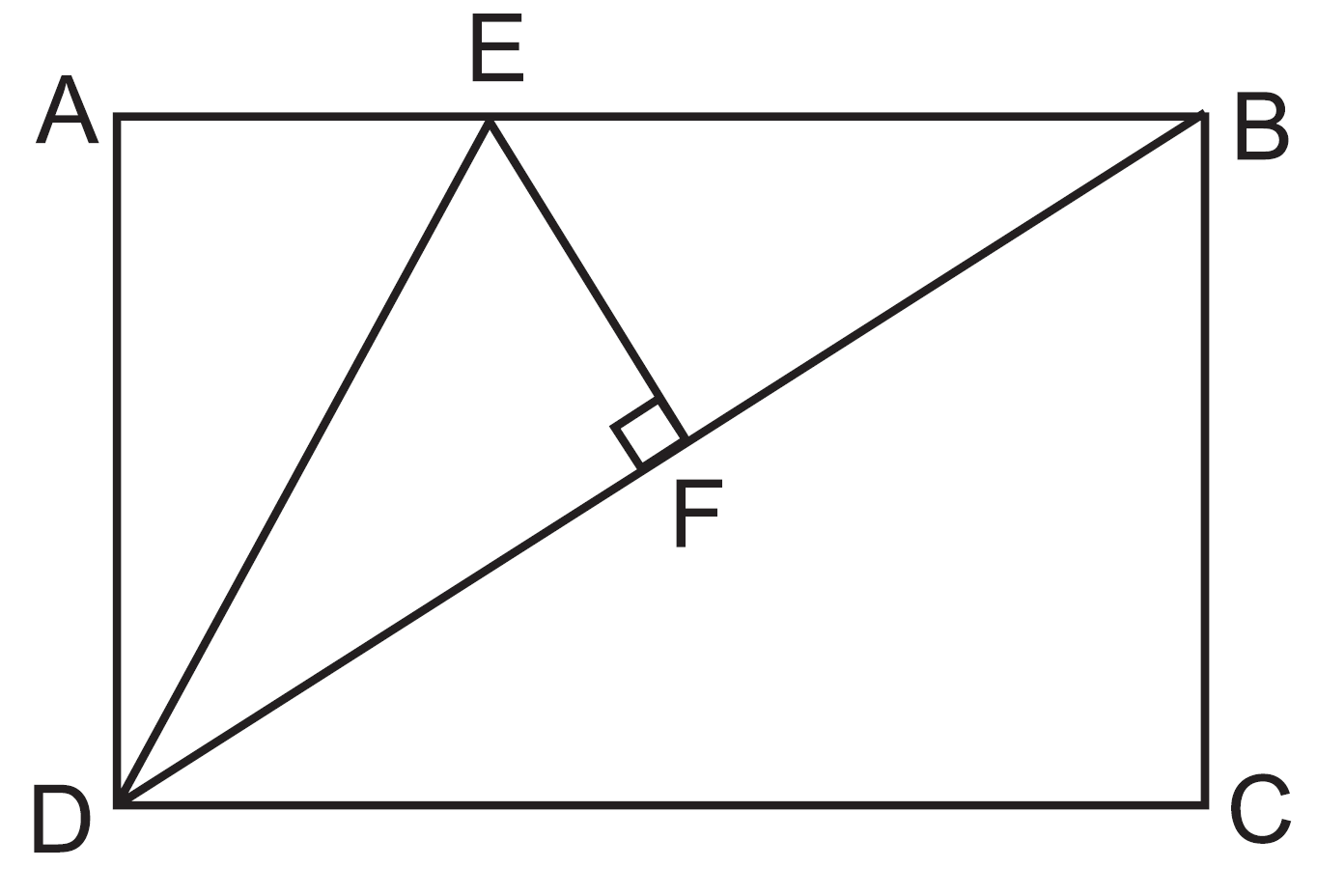
In the given figure, ABCD is a rectangle with AD = 4 units and AE = EB. EF is perpendicular to DB and is half of DF. If the area of the triangle DEF is 5 sq. units, then what is the area of ABCD?
Aptitude
Area
Difficulty: Hard
Choose an option
-
A$18\sqrt{3}$ sq. units
-
B20 sq. units
-
C24 sq. units
-
D28 sq. units
Answer
Correct Answer: 24 sq. units
Explanation
### Concept & Pythagorean Theorem in Area Calculations
By utilizing given area relations and right-angled triangles, we can deduce unknown side lengths step-by-step to find the dimensions of the larger rectangle.
### Step-by-Step Solution
* Given $\triangle DEF$ is a right-angled triangle (since $EF \perp DB$) with area 5 sq. units.
* Given $EF = \frac{1}{2}DF$. Let $EF = x$, then $DF = 2x$.
* Area of $\triangle DEF = \frac{1}{2} \cdot \text{base} \cdot \text{height} = \frac{1}{2} \cdot DF \cdot EF = \frac{1}{2} \cdot (2x) \cdot x = x^2$.
* Since Area = 5, $x^2 = 5$, meaning $EF = \sqrt{5}$ and $DF = 2\sqrt{5}$.
* In right $\triangle DEF$, applying Pythagoras theorem to find hypotenuse $DE$:
$$DE^2 = EF^2 + DF^2 = (\sqrt{5})^2 + (2\sqrt{5})^2 = 5 + 20 = 25$$
* Therefore, $DE = 5$ units.
* In right $\triangle DAE$ (corner of rectangle ABCD), $AD = 4$ units and hypotenuse $DE = 5$ units.
* Apply Pythagoras theorem to find $AE$: $AE = \sqrt{DE^2 - AD^2} = \sqrt{25 - 16} = \sqrt{9} = 3$ units.
* Given $AE = EB$, so $AB = 2 \cdot AE = 2 \cdot 3 = 6$ units.
* The area of rectangle $ABCD = AB \cdot AD = 6 \cdot 4 = 24$ sq. units.
### Exam Strategy & Shortcut
Recognize the classic 3-4-5 right triangle. Once you find $DE = 5$ and know $AD = 4$, $AE$ must be 3. Since $E$ is the midpoint, the full length $AB$ is 6. Area is simply $6 \times 4 = 24$.
### Common Pitfall
Misinterpreting the relation between $EF$ and $DF$, or failing to identify $\triangle DAE$ as a right-angled triangle with sides 3-4-5.
### Final Answer
Therefore, the correct answer is **24 sq. units**.