
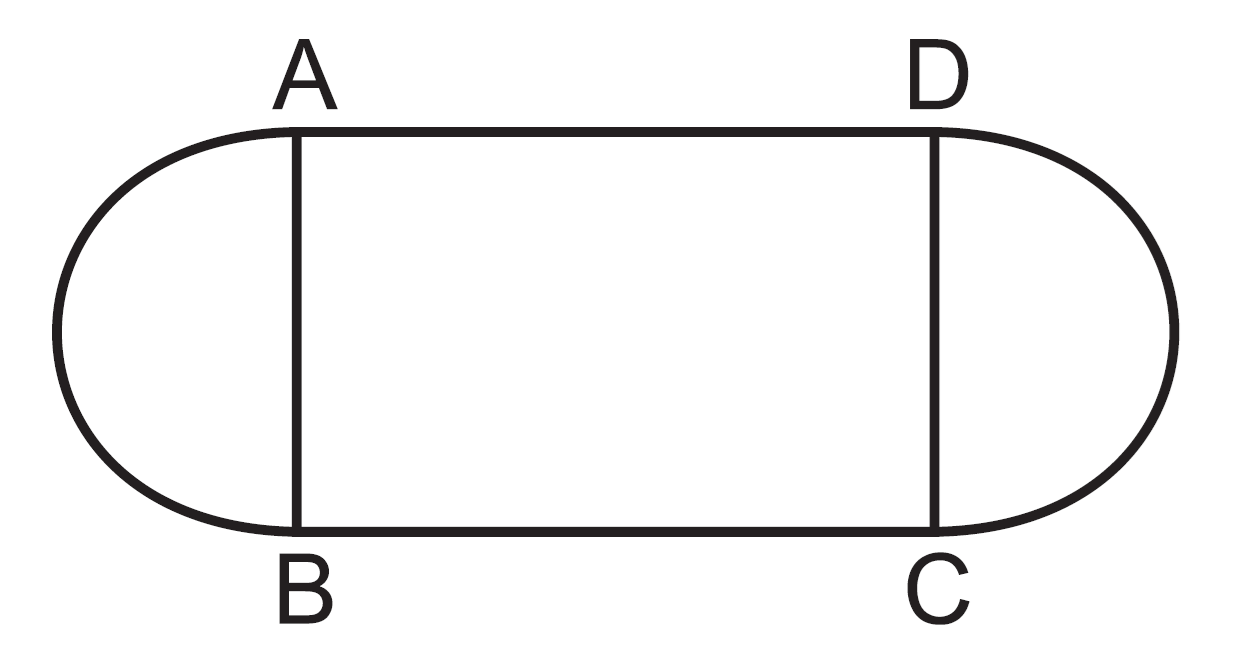
In the given diagram, $ABCD$ is a square and semi-circular regions have been added to it by drawing two semi-circles with $AB$ and $CD$ as diameters. If the total area of the three regions is $350$ sq. cm, then the length of the side of the square is equal to
Aptitude
Area
Difficulty: Medium
Choose an option
-
A$5\sqrt{7}$ cm
-
B$7$ cm
-
C$13$ cm
-
D$14$ cm
Answer
Correct Answer: $14$ cm
Explanation
### Concept & Area of Composite Figures
The figure is composed of a central square and two identical semi-circles extending outwards. Since the semi-circles share the side length of the square as their diameter, they can logically be combined into exactly one complete circle.
Formulas:
$$ \text{Area of square} = \text{side}^2 $$
$$ \text{Area of circle} = \pi r^2 = \frac{\pi d^2}{4} $$
### Step-by-Step Solution
1. Let the side of the square $ABCD$ be $x$ cm. Consequently, the diameter of both semi-circles is also $x$ cm.
2. The area of the central square is $x^2$.
3. The two semi-circles combine to form a full circle with diameter $x$ (meaning its radius is $\frac{x}{2}$).
Area of these two semi-circles combined $= \pi (\frac{x}{2})^2 = \frac{\pi x^2}{4}$.
4. Set up the equation for the total given area:
$x^2 + \frac{\pi x^2}{4} = 350$
5. Substitute $\pi = \frac{22}{7}$ to solve:
$x^2 (1 + \frac{22}{28}) = 350$
$x^2 (1 + \frac{11}{14}) = 350$
$x^2 (\frac{25}{14}) = 350$
6. Solve for $x$:
$x^2 = 350 \times \frac{14}{25} = 14 \times 14 = 196$
$x = \sqrt{196} = 14$ cm.
### Exam Strategy & Shortcut
Notice the total area equation: $x^2(1 + \pi/4) = x^2(25/14)$. The fractional factor $25/14$ tells us that $x^2$ must ideally be a multiple of $14$ to yield a clean integer total like $350$. Checking the options, $14$ is an extremely strong candidate. Testing it: $14^2 \times (25/14) = 14 \times 25 = 350$. It matches perfectly.
### Common Pitfall
A common mistake is treating the two semi-circles as having a *radius* of $x$ instead of a *diameter* of $x$, which inflates the area of the circular components by a factor of 4.
### Final Answer
Therefore, the correct answer is **14 cm**.