
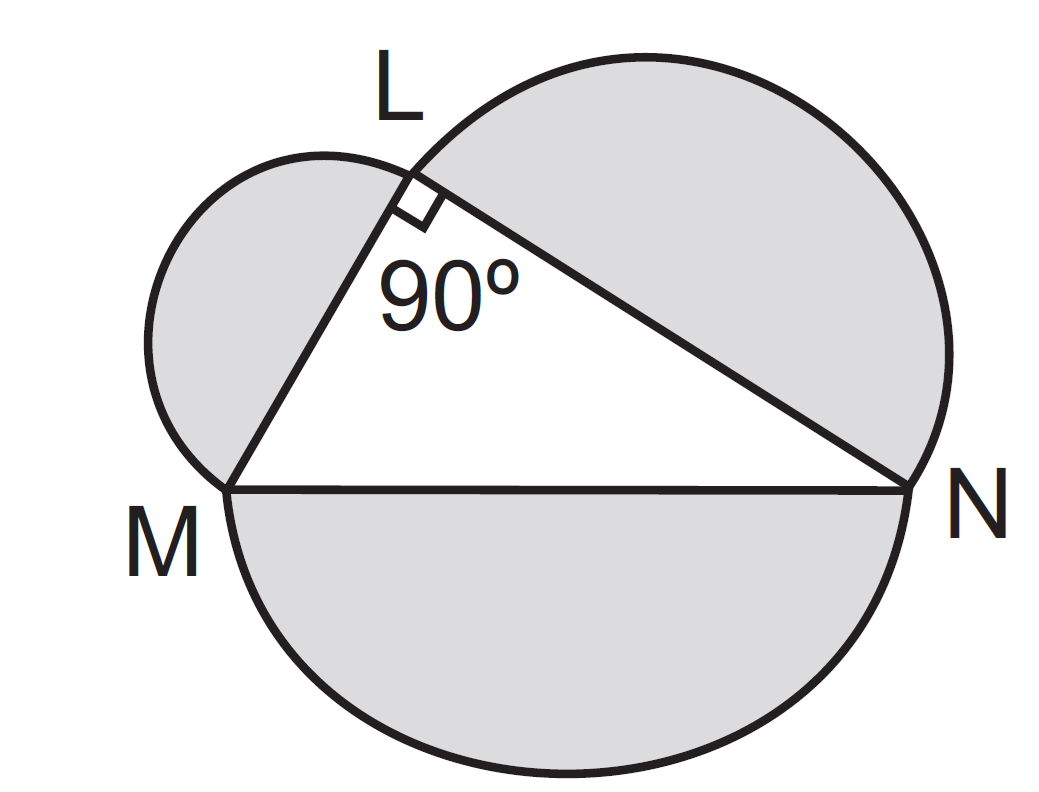
If $MN = x$, then what is the area of the shaded region?
Aptitude
Area
Difficulty: Medium
Choose an option
-
A$\pi x^2$
-
B$\frac{\pi x^2}{2}$
-
C$\frac{\pi x^2}{2}$
-
D$\frac{\pi x^2}{4}$
Answer
Correct Answer: $\frac{\pi x^2}{4}$
Explanation
### Concept & Area of Semicircles
The shaded region consists of three distinct semicircles drawn outwards on the three sides of a right-angled triangle. Note that any triangle inscribed in a semicircle with the diameter as its base is a right-angled triangle.
Formulas:
$$ \text{Area of semicircle} = \frac{\pi r^2}{2} $$
$$ \text{Pythagoras Theorem: } a^2 + b^2 = c^2 $$
### Step-by-Step Solution
1. We are given the hypotenuse $MN = x$. The area of the large shaded semicircle drawn on $MN$ is $\frac{1}{2} \pi (\frac{x}{2})^2 = \frac{\pi x^2}{8}$.
2. The remaining shaded areas are the two semicircles drawn on the legs $LM$ and $LN$.
3. The sum of the areas of these two smaller semicircles is:
$\frac{1}{2} \pi (\frac{LM}{2})^2 + \frac{1}{2} \pi (\frac{LN}{2})^2 = \frac{\pi}{8} (LM^2 + LN^2)$.
4. According to the Pythagoras theorem, $LM^2 + LN^2 = MN^2 = x^2$.
5. Therefore, the combined area of the semicircles on $LM$ and $LN$ is also $\frac{\pi x^2}{8}$.
6. Total shaded area = (Area of semicircle on $MN$) + (Area of semicircles on $LM$ and $LN$) = $\frac{\pi x^2}{8} + \frac{\pi x^2}{8} = \frac{\pi x^2}{4}$.
### Exam Strategy & Shortcut
For any right-angled triangle, the sum of the areas of similar shapes (like semicircles) drawn on the two legs is always exactly equal to the area of the similar shape drawn on the hypotenuse. Thus, the total shaded area is simply $2 \times$ (Area of the large semicircle) = $2 \times (\frac{\pi x^2}{8}) = \frac{\pi x^2}{4}$.
### Common Pitfall
A common mistake is trying to determine the individual lengths of $LM$ and $LN$, which is impossible with the given data and unnecessary since they resolve naturally through the Pythagorean identity.
### Final Answer
Therefore, the correct answer is **$\frac{\pi x^2}{4}$**.