
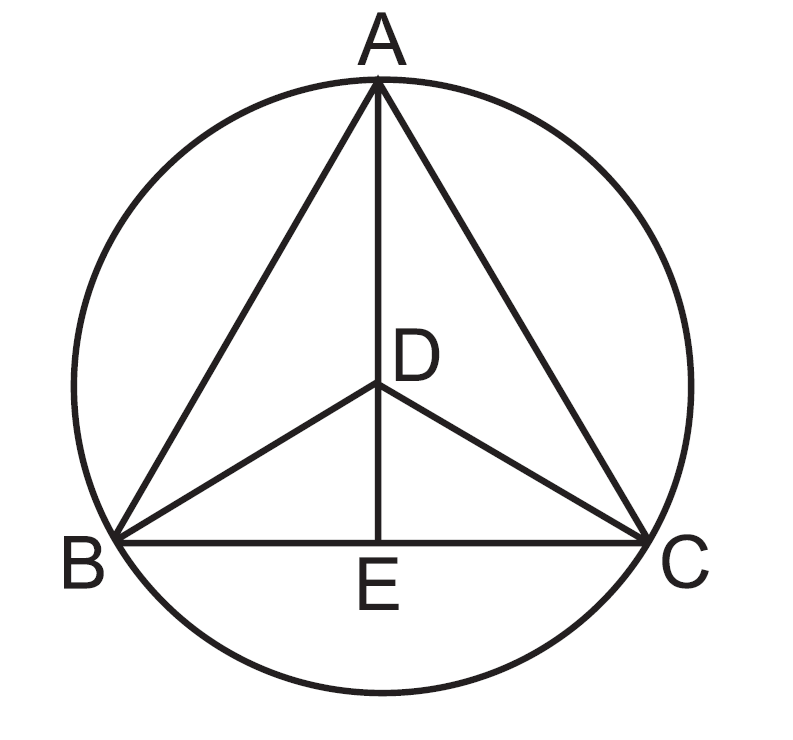
In the given figure, $ABC$ is an equilateral triangle which is inscribed inside a circle and whose radius is $r$. Which of the following is the area of the triangle?
Aptitude
Area
Difficulty: Hard
Choose an option
-
A$(r + DE)^{\frac{1}{2}} (r - DE)^{\frac{3}{2}}$
-
B$(r - DE)^{\frac{1}{2}} (r + DE)^2$
-
C$(r - DE)^2 (r + DE)^2$
-
D$(r - DE)^{\frac{1}{2}} (r + DE)^{\frac{3}{2}}$
Answer
Correct Answer: $(r - DE)^{\frac{1}{2}} (r + DE)^{\frac{3}{2}}$
Explanation
### Concept & Area of a Triangle
The area of a triangle is given by the standard formula:
$$\text{Area} = \frac{1}{2} \times \text{Base} \times \text{Height}$$
Here, we must express the base $BC$ and the height $AE$ (where $E$ is the foot of the perpendicular from $A$ to $BC$ passing through center $D$) in terms of the circle's radius $r$ and the given segment $DE$.
### Step-by-Step Solution
1. **Determine the Height:**
The line segment passing from vertex $A$ through center $D$ to the base $BC$ at point $E$ is the height of the equilateral triangle.
$AD$ is the radius $r$. Thus, the total height is $AE = AD + DE = r + DE$.
2. **Determine the Base:**
In the right-angled triangle $\triangle BDE$, the hypotenuse $BD$ is also a radius $r$.
Using the Pythagorean theorem: $BE^2 + DE^2 = BD^2$
$BE^2 = r^2 - DE^2 \implies BE = \sqrt{r^2 - DE^2}$
The full base $BC$ is twice $BE$, so $BC = 2\sqrt{r^2 - DE^2}$.
3. **Calculate the Area:**
$\text{Area} = \frac{1}{2} \times BC \times AE$
$\text{Area} = \frac{1}{2} \times \left(2\sqrt{r^2 - DE^2}\right) \times (r + DE)$
$\text{Area} = \sqrt{(r - DE)(r + DE)} \times (r + DE)$
$\text{Area} = (r - DE)^{\frac{1}{2}} (r + DE)^{\frac{1}{2}} (r + DE)^1 = (r - DE)^{\frac{1}{2}} (r + DE)^{\frac{3}{2}}$
### Exam Strategy & Shortcut
Recognize that $\sqrt{r^2 - DE^2}$ factors into $\sqrt{r-DE}\sqrt{r+DE}$. When you multiply this by the height $(r+DE)$, the $(r+DE)$ terms combine their exponents ($1/2 + 1 = 3/2$), immediately leading to option (d).
### Common Pitfall
Failing to recognize that $AD$ and $BD$ are both radii ($r$) of the circumcircle. Students often get stuck looking for the side length of the equilateral triangle using trigonometry, which makes the algebra much messier than simply using the Pythagorean theorem on $\triangle BDE$.
### Final Answer
Therefore, the correct answer is **$(r - DE)^{\frac{1}{2}} (r + DE)^{\frac{3}{2}}$**.