
**Directions:** Study the following information carefully and answer the given questions.
There are two cars, Car 1 and Car 2, with 9 persons (A to I) traveling. One car has 5 persons, and other car has 4 persons. All of them are facing south as seated in each row of each car. Each car has three seats at the back and two seats at the front, such that one of the back seat in one car is vacant. Also, consecutively named persons are not sitting adjacent to each other (neither beside/front/back nor above/below). Car 2 is placed above the Car 1. The seats are arranged in two rows in each car, with the following seat numbers in each car as shown in the diagram:
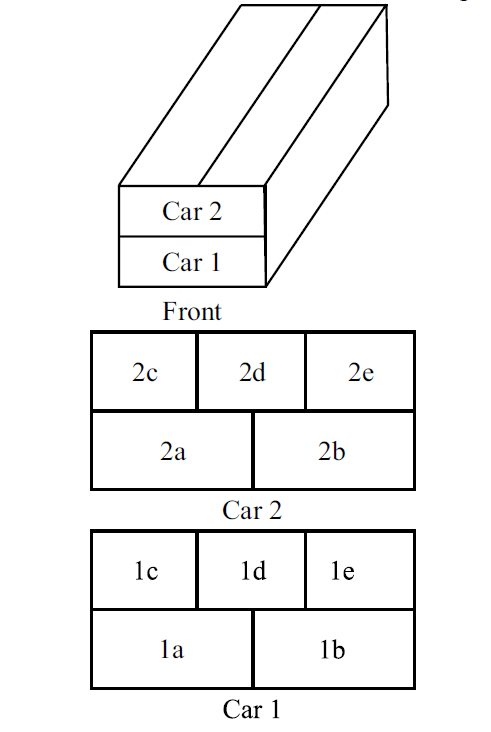 A is seated in Car 1, either in seat 1a or 1b. No one is seated between B and E. No one is seated behind E. F is seated in Car 2 and in the same row with B. I is just diagonally above C. No one is to the left of G. D is not seated adjacent to I. The seat just behind C is not vacant. D is not seated in the middle of the row of seats.
Who among the following is seated in 1d?
A is seated in Car 1, either in seat 1a or 1b. No one is seated between B and E. No one is seated behind E. F is seated in Car 2 and in the same row with B. I is just diagonally above C. No one is to the left of G. D is not seated adjacent to I. The seat just behind C is not vacant. D is not seated in the middle of the row of seats.
Who among the following is seated in 1d?
Verbal Reasoning
Seating Arrangement
Difficulty: Hard
Choose an option
-
AH
-
BD
-
CG
-
DNo one
-
EF
Answer
Correct Answer: No one
Explanation
### Concept & Logic
This is a complex constraint-satisfaction puzzle involving grid seating, directionality (facing South), and adjacency rules (no consecutively named persons are adjacent).
### Step-by-Step Solution
1. **Identify the Grid and Facing Direction:** Cars have a front row (2 seats: a, b) and a back row (3 seats: c, d, e). Facing south means the left of a person corresponds to the viewer's right.
2. **Place Car 2 Back Row:** B and E have no one between them, and F is in the same row as B. Since the front row only has 2 seats, B, E, and F must occupy the 3-seat back row of Car 2 (2c, 2d, 2e).
3. **Apply Adjacency Rule for B, E, F:** E and F are consecutive letters, so they cannot sit together. Thus, B must sit between them. The order is E-B-F or F-B-E. Since E has "no one behind E" (it is a back row seat), this holds perfectly.
4. **Place C, A, and I:** "The seat just behind C is not vacant" means C is in a front row. A is in 1a or 1b. Thus, A and C occupy 1a and 1b. I is "diagonally above C". If C were in 1a, I would be in 2b, leaving 2a for H. But H and I are consecutive and cannot be adjacent. Therefore, C must be in 1b, A is in 1a, and I is diagonally above C in 2a.
5. **Place G:** "No one is to the left of G". Facing south, this means G is at the extreme right of the viewer (the 'b' or 'e' column). With 1b (C) and 2e (E or F) taken, and knowing I is in 2a, G must be in 2b.
6. **Find the Vacant Seat:** Car 2 is full (F, B, E in back; I, G in front). The vacant seat is in Car 1's back row. C is in 1b, so 1e (behind C) is not vacant. D cannot be in the middle (1d). Thus, 1d is the vacant seat.
7. **Place D and H:** D cannot be adjacent to I(2a). If D is in 1c (below F), he is not adjacent to I. H takes the last seat 1e. This means E must be in 2e (above H, OK) and F must be in 2c (above D, OK) to satisfy consecutive letter rules.
8. **Conclusion:** The seat 1d is the vacant seat.
### Exam Strategy & Shortcut
Focus on the most restrictive clues first. The 3-person cluster (B, E, F) immediately fills Car 2's back row. Realizing that E and F are consecutive immediately forces B into the middle seat (2d). Tracking the "vacant seat" logic alongside "D is not in the middle" quickly isolates 1d as the empty space without even finishing the entire grid.
### Common Pitfall
Forgetting that the passengers are facing **South**. This reverses their left and right relative to the viewer. If you incorrectly place G on the viewer's left, the entire seating arrangement collapses.
### Final Answer
Therefore, the correct answer is **No one**.