
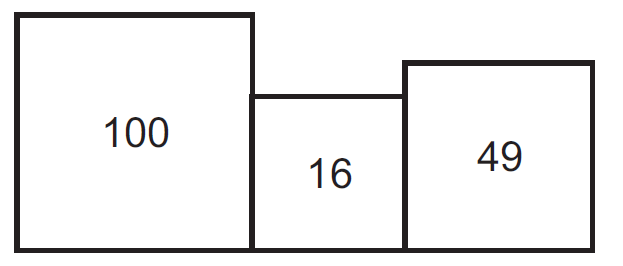
The adjoining figure contains three squares with areas of 100, 16 and 49 lying side by side as shown. By how much should the area of the middle square be reduced in order that the total length PQ of the resulting three squares is 19?
Aptitude
Area
Difficulty: Medium
Choose an option
-
A$\sqrt{2}$
-
B2
-
C4
-
D12
Answer
Correct Answer: 12
Explanation
### Concept & Logic
The total length of squares placed side by side is the sum of their individual side lengths. The side length of a square is the square root of its area.
$$ \text{Side} = \sqrt{\text{Area}} $$
### Step-by-Step Solution
1. **Find current side lengths:**
- First square: Area = $100 \Rightarrow$ Side = $\sqrt{100} = 10$.
- Middle square: Area = $16 \Rightarrow$ Side = $\sqrt{16} = 4$.
- Third square: Area = $49 \Rightarrow$ Side = $\sqrt{49} = 7$.
2. **Determine required side length of the middle square:**
- The desired total length $PQ$ is $19$.
- Let the new side of the middle square be $x$.
- $10 + x + 7 = 19$
- $17 + x = 19 \Rightarrow x = 2$.
3. **Calculate the reduction in area:**
- The new area of the middle square must be $x^2 = 2^2 = 4$.
- Original area = $16$.
- Reduction required = $16 - 4 = 12$.
### Exam Strategy & Shortcut
Write down the sides directly by taking square roots: $10, 4, 7$. Their sum is $21$. To reduce the sum to $19$, the middle side must decrease by $21 - 19 = 2$. So the new side is $4 - 2 = 2$. Its new area is $2^2 = 4$. The reduction is $16 - 4 = 12$.
### Common Pitfall
A common error is to just state the new area ($4$) as the answer instead of the *reduction* in area ($12$). Always re-read the exact question asked.
### Final Answer
Therefore, the correct answer is **12**.