
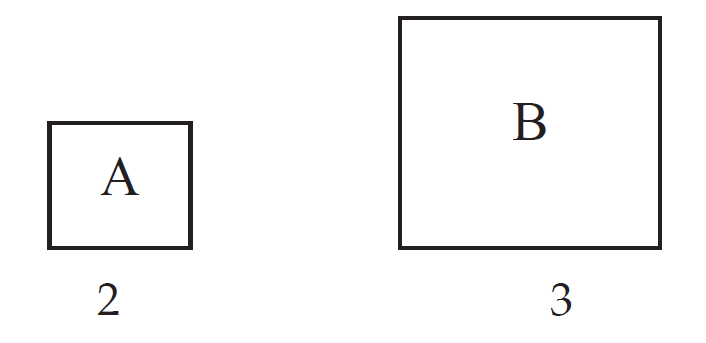
The following squares represent the monthly incomes of two families
 Aptitude
Area
Difficulty: Medium
Aptitude
Area
Difficulty: Medium
Choose an option
-
A₹ 50000
-
B₹ 60000
-
C₹ 90000
-
D₹ 120000
Answer
Correct Answer: ₹ 90000
Explanation
### Concept & Proportional Scaling
When quantities like income are represented by 2D shapes (like squares) in statistical diagrams, the area of the shape represents the magnitude of the quantity, not just the side length.
$$ \frac{\text{Income}_A}{\text{Income}_B} = \frac{\text{Area}_A}{\text{Area}_B} = \frac{\text{Side}_A^2}{\text{Side}_B^2} $$
### Step-by-Step Solution
- **Given**: Square A has side 2. Square B has side 3. Income of A is ₹ 40,000.
- Calculate the area of Square A: $2^2 = 4$ units.
- Calculate the area of Square B: $3^2 = 9$ units.
- Establish the equivalence: 4 area units corresponds to ₹ 40,000.
- Find the value of 1 area unit: $40,000 / 4 =$ ₹ 10,000.
- Calculate the income for family B based on its area: $9 \text{ units} \times 10,000 =$ ₹ 90,000.
### Exam Strategy & Shortcut
Recognize that area scales with the square of the sides. The ratio of their areas is $2^2 : 3^2 = 4 : 9$. If 4 parts = 40k, then 9 parts = 90k. This skips explicit unit calculations and goes straight to the answer.
### Common Pitfall
Assuming the income scales linearly with the side length. If you do this, you might calculate: $2 \text{ units} = 40,000 \implies 1 \text{ unit} = 20,000 \implies 3 \text{ units} = 60,000$, which leads to the incorrect option (b).
### Final Answer
Therefore, the correct answer is **₹ 90000**.